International
Berths held for invited international artists, galleries and cultural organizations bringing their voice to Kep.
11–14 December 2026 · Kep International Art Week
A tide of makers meets a fleet of hulls.
For artists, collectives and communities answering the call.
Ten hulls from the Kep coast, offered to be answered as contemporary artworks during Kep International Art Week 2026. Ten is the minimum — more hulls join as new partners answer.
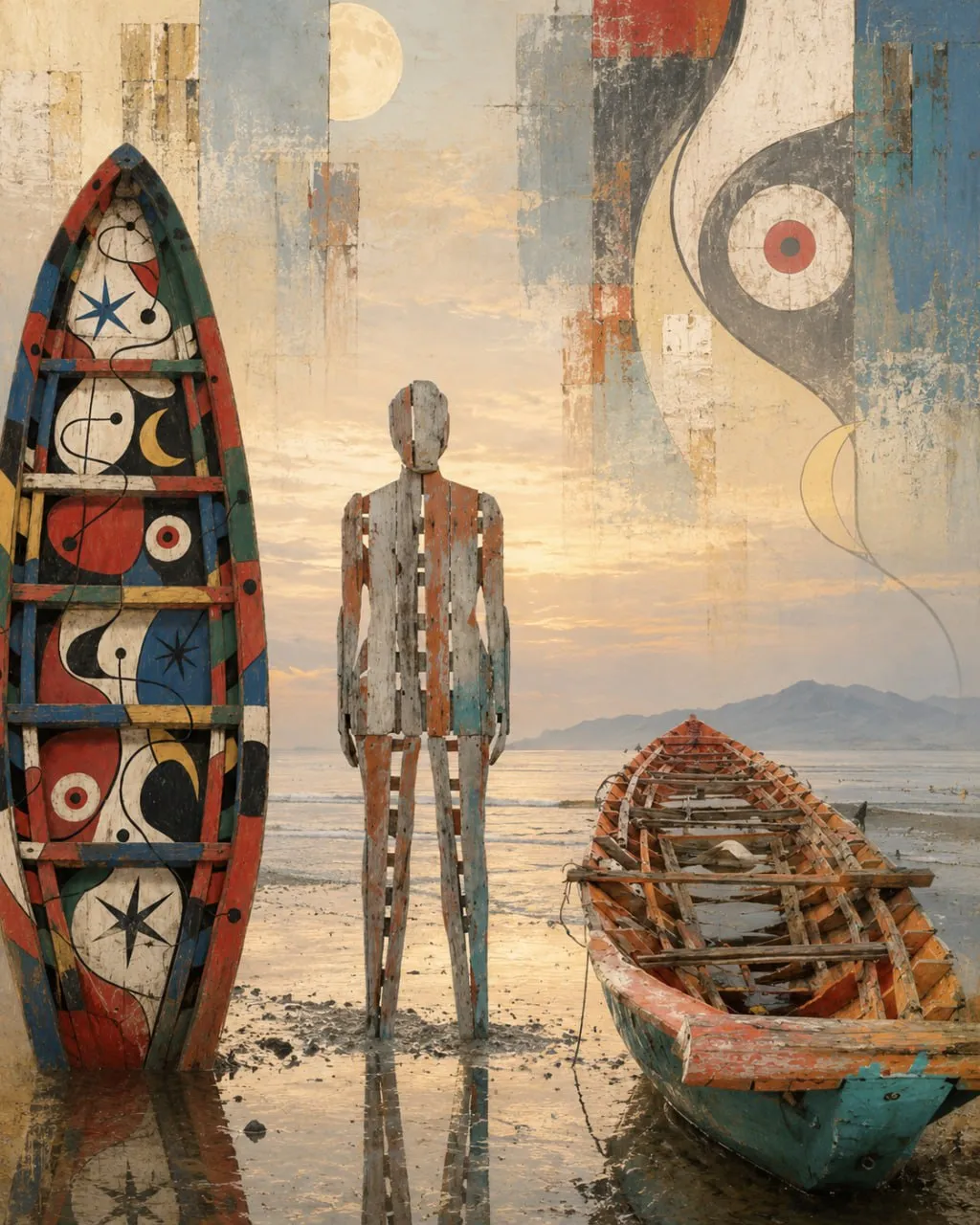
Kep is a small coastal town shaped by fishing boats, painted villas, and generations of life connected to the sea. Its shore has known leisure, conflict, and quiet. Today, a new chapter is emerging — one shaped through art, community, and making together.
For Kep International Art Week 2026, Art for Kep invites artists, collectives, organizations, and communities to transform ten or more retired wooden fishing hulls, offered by local fishermen who can no longer sail them.
Each participant is invited to respond in their own way. A hull may remain whole and be transformed into a contemporary artwork, or it may be reimagined entirely — opened, deconstructed, and its timber used as material for new work.
Through these transformations, the project gives new life and meaning to vessels once connected to Kep’s fishing communities, creating a new artistic language of the coast — shaped by artists, communities, and the sea.
Curator’s statement · Edition 01 · December 2026 · Kep, Cambodia
Ten Boats is a translation. Each hull on this coast holds a history written by the sea — the hands that built it, the seasons it survived, the coast it fed. We entrust ten of them to ten authors, each free to keep the boat whole or to fully re-author it. What lands on the shore of Kep in December is not a fleet, but a commission: the sea’s memory, placed in the hands of the makers of our time.
The sea is the first author.
The hull is the second.
The artist is the third.
Ten boats. Ten translations. One shore.
The thesis
The hulls we are receiving are not props. They are documents. Each one carries the handwriting of the family that built it, the water it kept out, the paint it was given when a season was good.
The invitation is simple. Take one hull. Answer it. Return it to the shore as a work that speaks for the coast that made it — and for the coast that is coming.
“The boat is not a setting. It is a co-author of the work.”
The coast speaks in signs
A private alphabet of the shore — stars, moons, birds, tides, and eyes. The signs a coast draws for those who know how to read them.
10+ — ten is the minimum, and more if the tide brings them. Ten is the foundation; more hulls join the programme as partners answer the call.
For artists. For organizations. For communities. For galleries.
Berths held for invited international artists, galleries and cultural organizations bringing their voice to Kep.
Berths reserved for Cambodian artists and collectives — authorship kept where the coast lives.
Berths made with fishing families, youth groups and NGOs of Kep — the makers of the shore.
One institutional berth for a museum or foundation partner. One left open. More join as partners answer.
The artist chooses
The choice is yours. Both pathways are equal. Hybrids welcome — just declare.
Use the whole boat, in any way you choose — translate it, transform it, take it apart, re-author it. Its timber becomes the material for a new work. The work need not preserve the vessel’s original form, but it should allow its material, memory, and connection to the sea to determine what it becomes.
Keep the hull whole. It stays a boat — painted, carved, inlaid, wrapped, rigged, planted, lit, sounded, filled or floated. Its silhouette remains legible from fifty metres. A visitor walking the beach still reads a fishing boat that has become something else.
One hull, two answers
Each hull enters the program with its own document: the family who built it, the years it sailed, its paint layers, its repairs, and the coordinates of the coast it worked. The passport travels with the boat for the rest of its life — and forms the ground on which the artist begins.
The hull is kept whole. Its silhouette remains a fishing boat, legible from fifty metres. The artist may paint it, carve it, wrap it, rig it, light it from within, plant it, or fill it with sound. A visitor walking the beach still reads a boat — one that has quietly become something else.
The boat is fully used — dismantled at The Yard with the fishing family present. Every plank is numbered, and its timber becomes the material for a new work: a woven wall, a standing screen, a hanging tapestry of grain and paint. The Plank Manifest hangs beside the finished piece.
The making
Transform a boat in Kep — or let us bring the boat to you. Choose the format that best supports your artistic practice.
Create and transform a boat during an Art for Kep residency, with optional support from local community members and access to indoor and outdoor working spaces in Kep.
We can deliver a boat to your own studio or atelier in Cambodia. You create the artwork in your location, and we collect it once production is complete.
The boat remains a co-author — whether the work is made at the shore or from afar.
The practicals
Projects for the 10 Boats+ programme are selected directly by the President and Vice President of Art for Kep, rather than through the standard selection committee.
Once accepted, Art for Kep will develop a sponsor map that artists and partners may use to seek additional support. While sponsorship cannot be guaranteed, we will help prepare a sponsorship dossier for your boat project.
If you bring collaborators or assistants, Art for Kep can provide two staff meals per person, per day, and assist in finding suitable accommodation within walking distance. Art for Kep does not have a budget to host additional workers.
Additional community support workers are available at USD 8 per person/day. Art for Kep contributes 50% of this cost and provides two additional meals per day for each worker.
Support requests are reviewed case by case. Please ask — every boat may require a different form of support.
What the boats become after
Selected works will travel to museums and biennales. Any future sales will be shared equally between the maker (artist) and Art for Kep NGO.
Selected hulls remain along the Kep shoreline as an outdoor collection — cared for by Art for Kep, carrying the Art Week into every season that follows.
Selected boats may be 3D-scanned and reproduced before returning to the sea, where they will take on a new purpose as artificial coral reefs.
What is set aside becomes cloth-of-gold. A boat, dismantled and re-woven, is the same idea in wood — the discarded returned to the eye, plank by plank.
Who this is for
Local and international. Individuals, collectives, artist-run initiatives. Any medium, provided the boat remains a co-author.
Cultural foundations, marine conservation groups, community associations. Bring a programme, bring a hull.
Fishing families of Kep, youth groups, schools, women’s cooperatives. The berth is a shared authorship.
Public and private galleries bringing an artist onto a hull. Your artist — our shore.
What Art for Kep provides
A retired wooden fishing boat, sourced by Art for Kep, delivered to The Yard.
A production stipend appropriate to scale — negotiated per berth.
Room and board during production.
Curatorial support, community hands from Kep’s region.
International press, curator visits, catalogue, digital archive with permanent boat coordinates.
Offering multiple afterlives.
How to answer · One short step
To every artist, organization, community and gallery who answers the ten hulls — thank you. The shore is waiting.