Cambodia & Art For Kep: Les Villas de Kep
- kepwest

- Jun 9
- 3 min read
Kep-sur-Mer was once a dream made concrete. Modernist villas rising from the jungle above a silken Gulf. French colonists and Khmer royalty. Prince Sihanouk shooting films in golden light. Then, almost overnight, the rockets came. And the silence that followed lasted decades — a silence inhabited only by ghosts, roots, and the sea.

It is into this silence that French writer Emmanuel Pézard has stepped. In residence at Knai Bang Chatt through the Art for Kep programme, he has spent months writing from within the very landscape he is reconstructing on the page — a strange loop of memory and invention, where the ruins outside his window become the stage for twelve short stories spanning a century of Cambodian history.
"From 1932 to 2026, twelve stories traverse a century of history in a seaside resort once nicknamed 'the little Saint-Tropez of Cambodia.'"
LES VILLAS DE KEP — GENERAL PRESENTATION
The collection is deliberately non-chronological. Pézard moves between eras not as a historian, but as a novelist who understands that memory itself is non-linear. The biting colonial satire of La Villa des Broussailles (1932) sits beside the tender tragedy of Pierre et la Villa de l'Espoir (1972). A fantastical ghost story from Bokor in 1940 brushes against a sumptuous gastronomic celebration in 1947. The effect is cumulative and polyphonic — a mosaic portrait of a place that has been, by turns, playground, paradise, and wound.
THE TWELVE STORIES
1932 La Villa des Broussailles | 1940 La Villa des Fantômes | 1945 La Villa des Amours |
1946 La Villa des Embruns | 1947 Le Coq à l'Âne | 1950 La Villa Apsara |
1960 Les Ruffians | 1969 Crépuscule | 1972 Pierre et la Villa de l'Espoir |
Epochs Miss Kep | 2009 La Villa des Bestioles | 2026 La Villa Renaissance |
Across these stories, a cast of characters weaves through the decades: cynical colonists and their servants, lovers separated by war, a submarine empire of vice hidden beneath a respectable façade, a royal filmmaker, a Corsican fixer, a one-eyed poet-saucier. Pézard writes in registers as varied as his subjects — black realism, fantasy, coming-of-age chronicle, moral fable — but a persistent sensibility unites them. He is drawn, above all, to the collision between power and tenderness: the places where colonial cynicism meets Khmer dignity, where brutality coexists with beauty.
THREAD | Running through the collection is Miss Kep — the story of a coastal statue through three lives and three destructions: colonial, post-independence, post-war. A meditation on identity, resilience, and the stubborn persistence of memory against erasure. |
The residency at Art for Kep has been, by Pézard's own account, a creative necessity. Writing about Kep from within Kep changes the work itself: the quality of afternoon light, the sound of the sea, the way overgrown vines embrace a crumbling modernist façade — these are not background, but material. The villas are not ruins to be observed from a safe distance. They are co-authors.
The final story, La Villa Renaissance — set in 2026 and anchored directly to Knai Bang Chatt — will see an elderly Frenchman return to the villa he fled in 1971 and transform it into a space for contemporary Khmer artists. A narrative symmetry: a collection born from ruins closes with an act of cultural rebirth. The weight of the past is not erased, but carried differently. Held in art, rather than stone.
"Between memory and fiction, a tribute to a country — blending darkness and light, cynicism and tenderness, to tell fragments of stories, behind which lies the greater one."
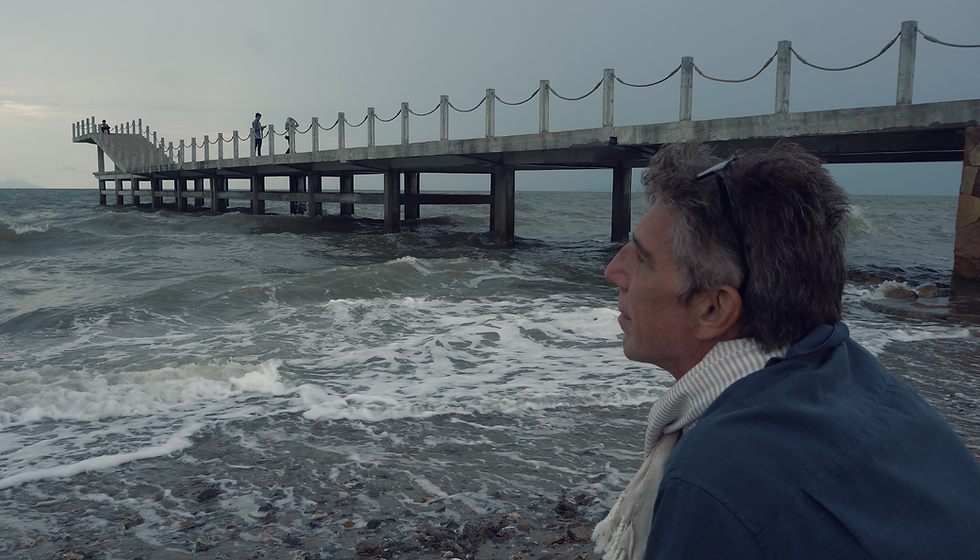
EMMANUEL PÉZARD, PROJECT NOTES
Les Villas de Kep stands at between 160 and 180 pages in final form. Its scope is unusual: not a novel but a collection that behaves like one, building a coherent world through accumulation and echo. The title — villas, plural — is deliberate. This is not one story of Kep, but many, stratified and overlapping, the way all true histories are.


Comments